
WinCrown · Welcome bonus200 free spins on selected slots
Reviews (9,827)
4.9Rating
Toplist · Litecoin casinos · 18+
 Best casinos available in AustraliaUpdated 7 November 2026
WinCrown · Welcome bonus200 free spins on selected slots
Reviews (9,827)
4.9Rating
A search for golden online casino does not lead to one business. “Golden” is among the most heavily used words in casino branding, and the results mix unrelated offshore operators, a well-known American brand that does not take Australian players, and copycat domains trading on all of them. Before any question about bonuses or pokies can be answered, the reader has to establish which company sits behind the page that has loaded. That takes a few minutes with the site footer and the terms, and everything else on this page follows from it.

Casino names are built from a small vocabulary: gold, royal, lucky, crown, star, vegas. The word “golden” appears in front of nuggets, crowns, stars, reels, lions and pokies, and the brands that result have nothing to do with one another. They are owned by different companies, hold different licences or none, and run on different platforms. Sharing an adjective means no more than two pubs sharing the name Royal Hotel.
This matters because reputation does not transfer. A good payout record at one golden-named site says nothing about the next, and a warning about one should not be pinned on another. Reviews, forum threads and complaint records are useful only when they concern the same legal entity as the site in front of you, and matching them by brand name alone is how readers end up trusting the wrong operator.
There is also a geographic split. Some brands with this word in the name are licensed in specific American states and serve only people physically located there. An Australian visitor cannot open an account, and a site claiming to be the Australian version of such a brand should be treated as an imitation until proven otherwise. The sites that do accept Australians are offshore operators, which this ledger does not certify.
Identification rests on three things, in descending order of reliability: the operating company, the licence, and the domain. The logo and colour scheme come nowhere, since they are the easiest parts to copy.
Five minutes of this produces a specific answer: this brand, operated by this company, under this licence, at this address. That is a thing that can be researched. “Golden casino” is not.
| Detail | What to expect | How to verify |
|---|---|---|
| Operating company | Full legal name and registration number | Company register of the stated country |
| Licence | Issuing body and a licence number | The issuer’s public register or validation page |
| Registered address | A street address, not only a country | Consistency with the company register entry |
| Payment agent | Sometimes a second company handling payments | Named in the terms; explains unfamiliar statement entries |
| Dispute route | A complaints contact or named mediator | Terms, under complaints or disputes |
Two points about licences need stating plainly. A foreign licence is not an Australian approval; no online casino is licensed here. And licences differ in what they demand. Some issuers publish registers, require player funds to be handled in particular ways and run a complaints process. Others ask for much less. The comparison is set out in our piece on Curaçao and Malta licensing.
A seal that cannot be clicked, a number that appears on no register, or a licence held by a company other than the one in the terms are all findings in themselves. They do not prove bad faith. They do mean the reader is being asked to rely on a claim nobody can check.

Offshore casinos serving Australians often change address. When ACMA has a domain blocked, the operator opens another with a number or an extra word added, and players are redirected. These mirrors are run by the same company and lead to the same accounts. Legitimate ones are announced inside the logged-in account or by the operator’s own support, and the login that worked yesterday works on the new address.
Clones are something else. A clone copies the look of a known brand on a domain controlled by a third party, to collect logins, card details or deposits. Popular names attract more of them, and a generic word such as “golden” gives a cloner endless plausible spellings to register.
The safe habit is to reach the site only from a bookmark made on a verified visit, and to treat any message supplying a new address as unconfirmed until support confirms it through the old channel.
Once the operator is identified, the terms repay a targeted reading. Most of the document is boilerplate. A handful of clauses determine what happens to the reader’s money, and they are in broadly the same places at every site.
| Clause | Usual heading | Why it matters |
|---|---|---|
| Withdrawal limits | Payments or withdrawals | Sets how fast a large balance can be paid, per day, week or month |
| Processing time | Payments | The operator’s own stated period for approving a payout |
| Verification | KYC or account verification | Lists documents and when they may be demanded |
| Dormant accounts | Inactive accounts | May allow fees or closure after a period without logins |
| Bonus rules | Promotions or bonus terms | Wagering, bet limits, excluded games and cash-out caps |
| Operator discretion | General or miscellaneous | How widely the operator may void winnings or close accounts |
The withdrawal limit is the one most often overlooked. A site may accept any size of deposit and pay any size of win, but release it in fixed instalments. For a modest balance that is irrelevant. After a large pokies feature, it decides whether the money arrives in days or over many months. Progressive jackpots are sometimes exempted, and the terms should say so.
Take a dated screenshot of the terms on the day of registration. Offshore operators revise their terms without much notice, and a dispute is far easier to argue with a copy of the wording as it stood.
Golden-branded sites advertise welcome packages like everyone else, and the headline figure is the least informative part. The example below uses invented numbers to show how an offer is costed. It does not describe the terms of any operator.
Suppose a site matches a first deposit dollar for dollar. The reader deposits A$100 and receives A$100 in bonus funds. The terms set wagering at 35 times the deposit plus the bonus. That is 35 × A$200, or A$7,000 in bets, before a withdrawal is permitted. If the pokies played return 96 per cent on average, the expected cost of A$7,000 in turnover is four per cent of it: A$280.
So the offer adds A$100 to the balance and carries an average cost of A$280 to release. Change one detail, wagering on the bonus alone, and the turnover halves to A$3,500 with an average cost of A$140. The wording “bonus” versus “deposit plus bonus” is worth more than the size of the match.
Averages hide the spread, of course. Some players clear the requirement well ahead, most do not, and a maximum bet rule limits how quickly anyone can try. The calculation is not a prediction. It is a way of comparing two offers on the same footing, and of deciding whether to play without one. This site’s method for weighing such terms is on the review method page.
Australian-facing offshore cashiers tend to offer a familiar mix: bank transfer by PayID, cards, prepaid vouchers such as Neosurf, e-wallets and several cryptocurrencies. Which of these a given golden-named site supports can be established only from its own cashier, viewed while logged in from Australia. Review pages, this one included, go out of date as processors change.
Three things are worth confirming before the first payment. First, that the account can be held in Australian dollars, since a balance in another currency is converted in both directions at a rate the player does not control. Second, that the method used to pay in also appears on the withdrawal list, or that an acceptable alternative does. Vouchers, for instance, are deposit-only by nature. Third, the minimum withdrawal on that method, which is frequently higher than the minimum deposit.
The payee shown for a bank transfer will usually be a payment agent, not the casino. That is standard practice offshore. It is also the detail a cloned site exploits, so the payee should be read from inside the verified account each time and never taken from a message.
Most offshore lobbies draw on the same studios, so two unrelated golden-named casinos may list hundreds of identical pokies. Identical titles do not guarantee identical games. Many studios supply each pokie in several return-to-player versions, and the operator chooses which to run. The same title can pay back a different long-run percentage at two sites.
The figure that applies is the one shown in the game’s own help or information screen at that casino, not the number quoted in a general review. Opening the paytable and scrolling to the last pages takes seconds. Where a game states no figure at all, the reader has no basis for comparison.
Australians should also know what is usually missing. The land-based cabinet games familiar from pubs and clubs are, for the most part, not offered by offshore casinos in their original form. What appears instead are online studios’ titles, some designed to resemble them. A lobby advertising the pub favourites by name deserves a second look at who actually supplied the software.
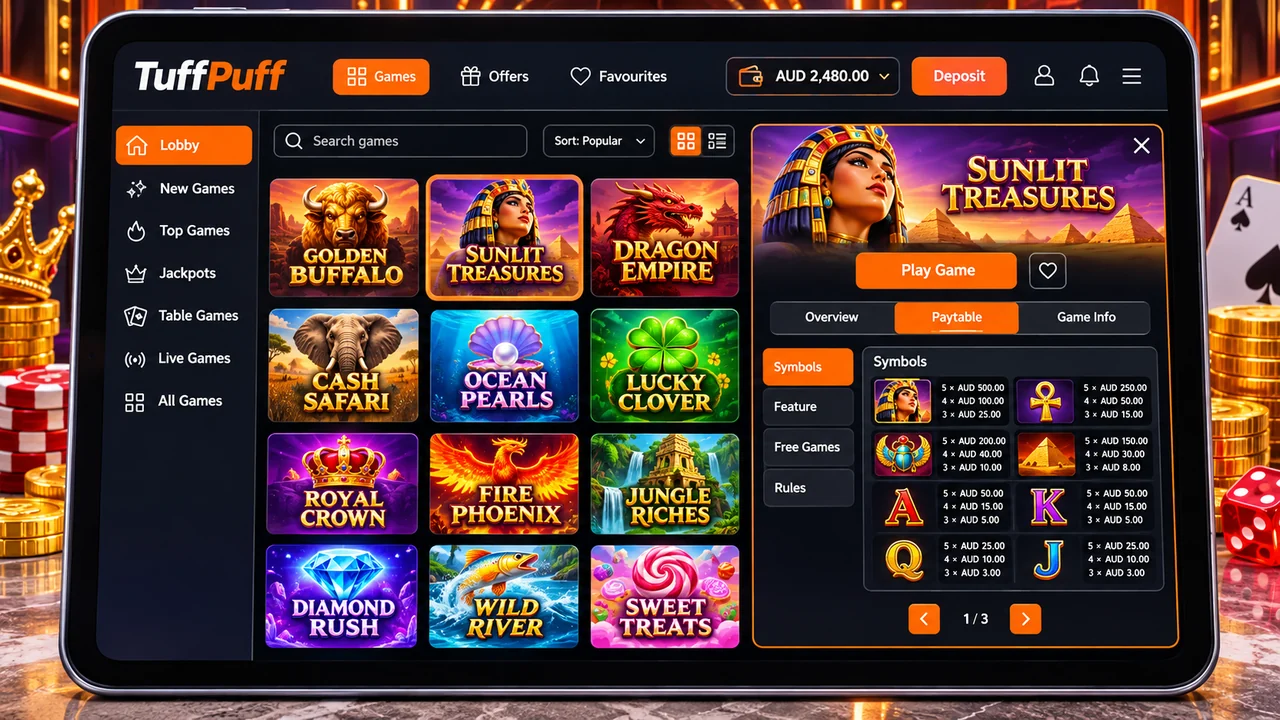
Offshore casinos are generally absent from the official Australian app stores, so what a golden-named site calls its app is usually one of two things. The first is a shortcut that opens the mobile website in a browser frame. It installs nothing of substance and carries little risk beyond that of the site itself. The second is an installation file offered for download directly from the casino’s domain, outside any store.
The second kind deserves real caution, and a generic brand name makes it worse. A file downloaded from a cloned domain is the most direct route by which a copycat can reach a phone’s contents. The mobile website offers the same games and cashier with none of that exposure. If a site insists that an installed file is required to play or to withdraw, that is unusual enough to count against it. Searching an app store for the brand and installing whatever shares the name is no safer, since unrelated social casino apps with gold in the title are common and have no connection to any real-money operator.
Everything above reduces to a short written record. It costs ten minutes and settles most later arguments.
If any line cannot be filled in from the site’s own pages, the gap is the finding. A reader who cannot name the company holding the money has not yet identified which casino this is, whatever the logo says.
The route for a dispute with an offshore operator is short. It begins with the site’s support, moves to a written complaint to the address in the terms, and ends with the licensing body or a mediator the terms name. Australian regulators do not adjudicate individual disputes with unlicensed offshore casinos. ACMA takes reports about illegal services and acts against operators, but it does not recover a player’s balance.
The strength of the final step depends on the licence. Some issuers run a structured complaints process with deadlines. Others forward the complaint to the operator and report its answer. For a site with no verifiable licence there is no step at all, and the outcome rests on the operator’s goodwill.
Evidence decides most cases that do get heard: the terms as they stood, the transaction records, the chat transcripts, the bonus rules at the time of the claim. A player who has kept those has an argument. One who has not is relying on the operator’s version of events.
The Interactive Gambling Act 2001 prohibits offering online casino games to people in Australia. The prohibition is aimed at operators and those who advertise them; it does not make playing an offence for the individual. ACMA maintains the enforcement, including requests to internet providers to block offending domains. The detail, and what a licence claim does and does not mean here, is in our guide to online casino licences in Australia.
Any golden-named casino open to Australians therefore operates offshore and outside local consumer protection. The operators listed at the top of this page are this site’s commercial partners; their placement is sponsored and is not a certification. Readers comparing recent launches may also find the notes on newest-casino lists useful. Gambling is restricted to adults aged 18 and over, and a spending limit set before the first deposit is the only one that reliably holds.
No. Many separate brands use the word, and they share neither ownership nor licensing. The company named in a site’s terms is the only reliable identifier.
It is a state-licensed brand in the United States and serves players located in those states. A site presenting itself as an Australian edition should be treated with suspicion and checked against the brand’s official channels.
A real seal links to a record on the issuing body’s own website showing the licence holder and status. An image with no link, or a link to a page on the casino’s own domain, proves nothing.
Operators move to new domains when earlier ones are blocked. A real mirror accepts the existing login and shows the same balance, and support will confirm it on request.
Nothing at all. Branding is chosen by a marketing team and has no connection to return percentages, jackpot sizes or the speed at which winnings are paid.