
WinCrown · Welcome bonus200 free spins on selected slots
Reviews (9,827)
4.9Rating
Guide · Australia
 Best casinos available in AustraliaUpdated 7 November 2026
WinCrown · Welcome bonus200 free spins on selected slots
Reviews (9,827)
4.9Rating
An advertised A$5 wallet deposit can involve two transfers: money into the wallet and money from the wallet to a merchant. Check the cost and rules at each step; a wallet logo does not authorise online casino services, which providers are prohibited from offering to people in Australia.
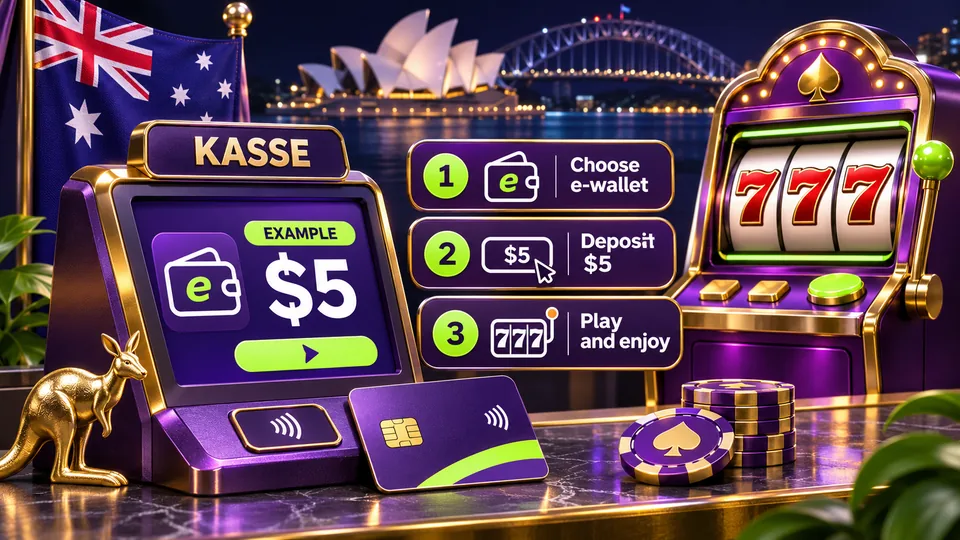
A small wallet payment involves three separate checks: whether the wallet can be funded, whether its terms allow the merchant category, and whether the merchant accepts that wallet in AUD. A five-dollar headline confirms none of these by itself.
A stored-balance e-wallet holds funds in a payment account. A card wallet can instead pass a linked card payment to a merchant, so two products described as “digital wallets” can have different funding, fee and withdrawal rules.
The five-dollar figure also needs careful interpretation. It can describe a minimum deposit advertised in a search result, a promotional claim or a user's intended budget, rather than a verified payment threshold.
Before treating a result as relevant, readers need to identify the operator's legal entity, the gambling product offered, the payment method supported and the applicable customer eligibility rules. These details determine what the search phrase means in practice.
The Interactive Gambling Act prohibits providers from offering online casino services, including pokies, to people in Australia. The Australian licence guide explains why a foreign licence and an AUD cashier do not supply permission.
There is a separate payment rule for licensed online and telephone wagering: since 11 June 2024, operators cannot accept credit cards, credit-card-linked funds through wallets, or digital currency. ACMA’s credit-ban guidance explains the scope, including the exception for other products such as lotteries.
A website displaying an Australian flag, prices in Australian dollars or an electronic wallet logo does not establish that its gambling service is lawful. Payment access and legal authorisation are separate questions.
Readers can consult ACMA's official information about illegal online gambling and the Interactive Gambling Act before considering an offshore website. State and territory gambling regulators also publish information relevant to locally regulated gambling products and consumer complaints.
A search result mentioning $5 does not confirm the minimum deposit for a specific account. Payment thresholds can differ between an operator's cashier, individual payment methods, account currencies and transaction types.
The relevant evidence is the operator's deposit page and the payment screen shown to an eligible customer. Readers need to distinguish the minimum deposit from any minimum transaction imposed by the wallet provider.
The cashier's displayed amount is not the only relevant figure. A wallet can apply its own funding, conversion or transfer conditions, while the gambling operator can impose separate account-level requirements.
The credited amount must be considered after both wallet funding costs and merchant-payment charges. If the cashier accepts A$5 but the wallet requires a larger top-up, the real amount committed can exceed the advertised minimum.
Electronic wallets differ in how they receive funds, verify customers and authorise transactions. Some rely on a linked bank account or card, while others use a stored balance or another supported funding arrangement.
The wallet provider's official fee schedule and transaction terms explain charges that are separate from gambling-site conditions. Its account eligibility rules also establish which customers can open and use the service.
Readers need to check the payment recipient before authorising a transfer. The name displayed during checkout, the transaction currency and the requested amount should match the transaction they intend to make.
A payment logo alone is weak evidence because logos can appear on pages that do not support the method for every customer. The actual cashier and the wallet provider's own documentation provide more useful confirmation.
Illustration only: if an A$5 budget loses A$0.25 to a wallet top-up fee and another A$0.25 to a merchant-payment fee, A$4.50 remains. If charges are added on top instead, the cash outlay would be A$5.50. Neither fee is a claim about a named provider.
Depositing money and withdrawing money are separate processes. A payment method that appears during account funding is not proof that the same method supports withdrawals from the gambling service.
The operator's withdrawal policy identifies permitted destinations, verification requirements, applicable fees and any transaction limits. Readers need to check the relevant section for the selected method rather than relying on a general payment-method list.
Identity verification can form part of lawful financial and gambling-related controls. The operator's account verification page explains the documents and information it requests, while the wallet provider explains its own verification process.
Before depositing, readers need to understand what happens when a withdrawal cannot return through the original payment method. The published withdrawal policy should identify available alternatives and explain the conditions for using them.
Compare this two-stage route with PayID recipient and transfer checks: PayID addresses a bank account, whereas a stored-balance wallet introduces a separate account and its own terms. Neither method proves that a casino is authorised or that cash-outs use the same route.
The advertised deposit is not necessarily the total cost of using an electronic wallet. Currency conversion, payment-provider charges and account funding conditions can affect the amount transferred or credited.
The wallet provider's fees page is the appropriate source for its charges. The gambling operator's deposit and withdrawal pages explain separate fees imposed by the gambling service, where applicable.
Readers also need to distinguish a payment fee from a gambling requirement. Deposit conditions, withdrawal thresholds and restrictions on account balances concern different stages of the transaction and belong to different policy sections.
For a wallet-funded account, a low entry amount does not establish that withdrawing a remaining balance is economical. Checking both sides of the transaction gives a more complete picture of the financial commitment.
A wallet may accept a funding card while refusing a gambling transaction, or permit deposits to a merchant while not supporting refunds or withdrawals from it. Read the provider’s gambling-use restrictions and the merchant’s cash-out policy as separate documents.
The following checklist separates the main claims from the official or account-specific evidence needed to assess them. It focuses on verifiable details rather than rankings, promotional language or unsupported recommendations.
| Question | Where to check | What the evidence establishes |
|---|---|---|
| Is the service lawful for Australians? | ACMA's official gambling guidance and applicable legislation | Relevant legal restrictions |
| Is the operator identifiable? | Legal information and operator details page | The stated contracting entity |
| Is a small deposit accepted? | Deposit page and eligible-account cashier | The displayed minimum for the selected method |
| What does the wallet charge? | Wallet provider's official fee schedule | Published payment and conversion charges |
| Can withdrawals use the wallet? | Operator's withdrawal policy | Supported withdrawal methods and conditions |
| What verification is required? | Operator's verification page and wallet account rules | Identity and account requirements |
| How can a complaint be raised? | Relevant regulator's official complaints guidance | Available reporting or complaint channels |
A completed checklist does not guarantee that a website is safe or that every transaction will succeed. It provides a documented basis for identifying unanswered questions before any payment takes place.
Electronic wallets can reduce the need to enter card details directly on every merchant page, but they do not make gambling transactions anonymous. Providers retain account and transaction information under their applicable policies and legal obligations.
Readers need to review the wallet provider's privacy notice for information about data collection, disclosure and retention. The gambling operator's privacy policy explains how it handles customer information and when it shares information with service providers.
Account security also requires attention to the website's domain, secure sign-in process and account recovery procedures. Unexpected requests for passwords, authentication codes or additional payments deserve scrutiny, particularly when they arrive outside the normal account interface.
Never share a wallet password or one-time authentication code with a person claiming to represent a gambling operator. Use the provider's official account interface to verify unexpected transaction requests or account alerts.
A small deposit is not evidence that gambling is financially harmless. Repeated deposits can accumulate, and an electronic wallet can make transactions easier without changing the underlying risks associated with gambling.
Australian readers can consult Gambling Help Online for information about gambling harm, support options and ways to manage gambling behaviour. State and territory services also publish local assistance and support information.
Set a spending limit that does not affect essential expenses, and do not treat gambling as a method of earning income or recovering losses. If gambling causes distress or financial difficulty, seek support rather than depositing more money.
Gambling is for people aged 18 and over. Responsible gambling means understanding the risks, keeping essential funds separate and seeking help when gambling becomes difficult to control.
No operator or current A$5 offer is verified here. The guide explains the checks needed for the wallet, the funding source and the merchant; it does not establish that online casino services may be offered in Australia.
No. Payment-provider fees, currency conversion and operator conditions can affect the total cost. Check the wallet provider's fee schedule and the gambling operator's deposit page for the applicable charges and credited amount.
No. Providers are prohibited from offering online casino services to people in Australia. For licensed online wagering, the separate credit ban also covers credit-card-linked funds sent through wallets.
Not necessarily. Some services distinguish between supported deposit methods and withdrawal destinations. The operator's withdrawal policy and the wallet provider's account rules establish the conditions applicable to each transaction.
No. Wallet providers and gambling operators can collect transaction, identity and account information under their privacy policies and legal obligations. Review both privacy notices to understand how information is handled and disclosed.
Check eligibility, gambling-use restrictions, funding sources, currency conversion and the fee schedule. Then check whether the merchant’s withdrawal policy actually supports that wallet rather than assuming deposits and cash-outs work alike.